United States of America Flag

United States:

AI Crash & Instant Games Algorithms Behind High-Speed Gambling Formats

AI-driven crash and instant games represent one of the fastest-growing segments in modern online casinos, defined by rapid gameplay loops, escalating multipliers, and real-time decision points that require precise algorithmic control. These high-speed formats rely on a combination of provably fair RNG mechanisms, volat behavioural analytics to produce outcomes that are both mathematically stable and engaging. As developers refine the underlying algorithms, the user experience becomes more dynamic, with visual pacing, crash curves, and risk distribution shaped by sophisticated design logic rather than simple static mechanics. This page examines how AI, modelling strategies, and real-time data processing influence the structure, performance, and fairness of crash and instant games across regulated iGaming platforms.

Explore More Content About AI in iGaming

ai crash instant games

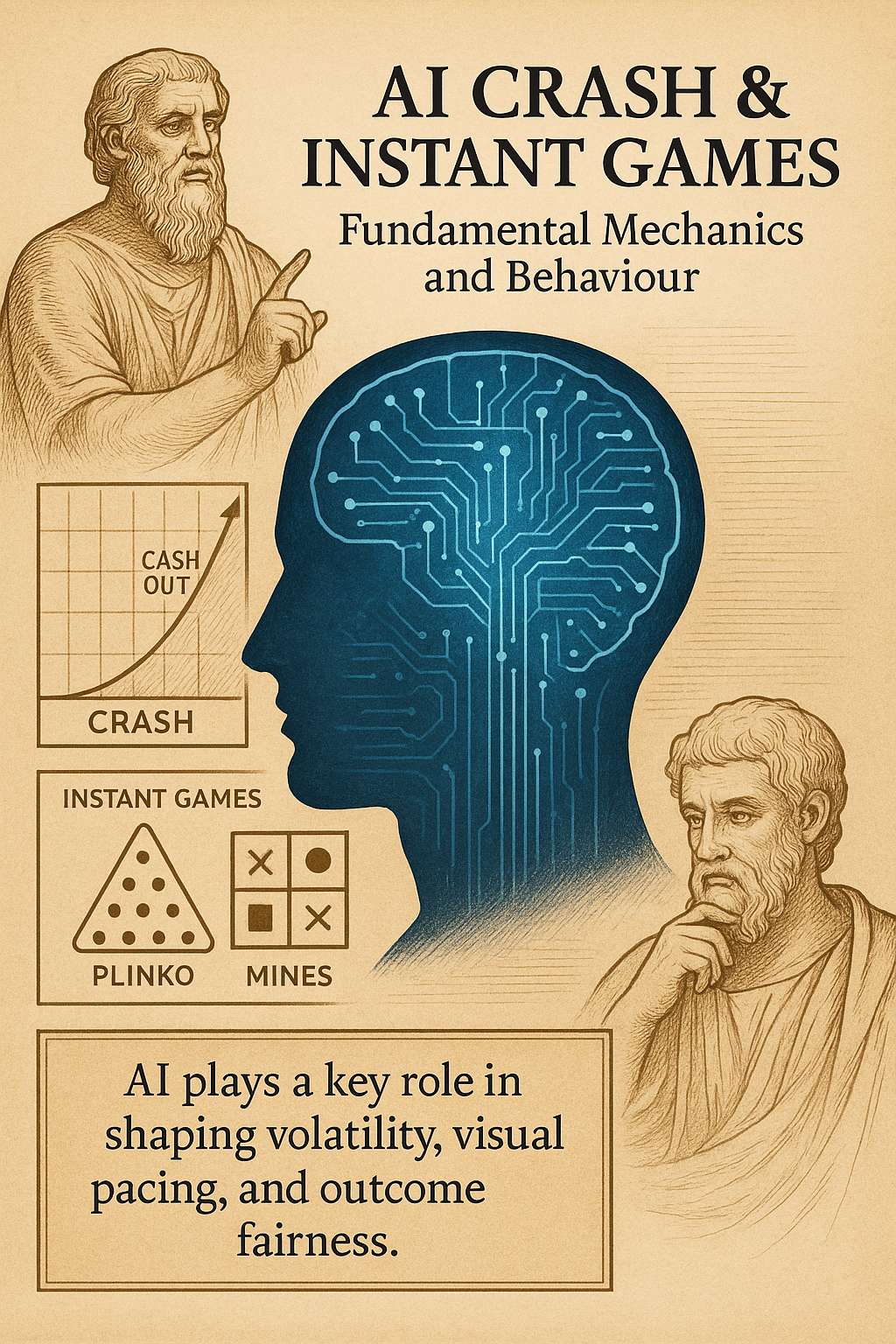
AI Crash & Instant Games: Fundamental Mechanics and Behaviour

AI-supported crash and instant games operate on tightly structured mathematical frameworks built for rapid iteration, high-frequency wagering, and immediate outcome delivery, making them fundamentally different from traditional slots or table games. Crash games run on a scalable multiplier curve that increases in real time until an RNG-defined crash point terminates the round, requiring players to make high-pressure decisions based on timing, volatility, and perceived risk. Instant games, such as Mines, Plinko, Towers, Boxes, and Jet-style titles, use compact grids, branching paths, or sequential reveals to generate fast independent outcomes, each governed by probability distributions that remain stable across thousands of rounds. These formats depend on lightweight execution engines designed for minimal latency, predictable RTP behaviour, scalable concurrency, and transparent randomness verification through provably fair protocols. Within this architecture, AI plays a formative role not by altering outcomes but by assisting developers and operators in calibrating volatility curves, modelling player tendencies, smoothing visual pacing, adapting session-level responsiveness, and analysing macro-level behavioural clusters across the player base. AI systems also contribute to structural fairness auditing, anomaly detection, and fraud prevention, ensuring that crash curves and instant outcomes remain consistent with published parameters. The integration of AI into these game types allows modern platforms to refine balancing models, improve responsible gambling intervention timing, and maintain operational stability even during high-volume peak periods.

Although AI does not influence the underlying RNG or determine winning outcomes, it increasingly shapes the behaviour, pacing, risk distribution, and protective oversight surrounding crash and instant games.

Together, these elements—mathematical engines, RNG integrity, AI-assisted modelling, and real-time behavioural analytics—form the essential foundation that defines how crash and instant games behave, scale, and deliver their high-speed casino experience across regulated iGaming environments.

Licensed Casinos Known for High-Quality Crash & Instant Game Integration

Below is a selection of online casinos that provide advanced crash and instant games supported by reliable algorithms, transparent RTP settings, and responsible gaming features powered by AI-driven monitoring systems.

Casinos: 5

Filter

Casinos: 5

Rating

Number of Slots

0

8,000

Number of Live Games

0

1,000

Bonus Amount

0

500

Free Spins

0

500

Welcome Bonus Percentage

0

100

Total Bonus Percentage

0

200

Bonus Types

Bonus Wagering

Software Provider

Payment Method

License

Languages

Crypto currency

Live Game

Game types

flag All American Casino
DuckyLuck Casino Logo

United States of America FlagRated 100/100%

Duckyluck Casino

Welcome bonus

500%/$2,500+ 150 Free Spins

x30 wagering (Bonus & Deposit)

flag All American Casino
Slotsandcasino Logo

United States of America FlagRated 100/100%

SlotsandCasino Casino

Welcome bonus

300%/$1,500 + 100 Free Spins

x30 wagering (Bonus & Deposit)

bonus Bonus Crab
WinBay-Casino-Logo

United States of America FlagRated 99.67/100%

WinBay Casino

Welcome bonus

100%/ €500+ 200 Free Spins

x12 wagering (Bonus & Deposit)

flag All American Casino
Live casinohouse svg

United States of America FlagRated 60/100%

Extreme Casino

Welcome bonus

200%/$1000

x10 wagering (Bonus & Deposit)

star Popular
Reels Grande Logo

United States of America FlagRated 60/100%

Reels Grande Casino

Welcome bonus

Up to $250 Weekly Cashback

x30 wagering (Bonus & Deposit)

5 / 5 100%

Algorithmic Logic in Crash & Instant Game Design

Understanding how AI personalizes the casino experience requires examining the data ecosystem that fuels these models. Each player's interaction becomes a signal, and when these signals are combined, they form adaptive behavioural profiles that evolve in real time. The boxes below outline the primary data layers influencing AI-driven personalization.

artificial intelligence

RNG Sequencing and Multiplier Termination

Crash games rely on continuous multiplier generation controlled by a random number generator that determines the precise moment the sequence ends. The algorithm ensures that each multiplier increment is mathematically independent, while the termination point is pre-calculated but concealed from the player. This structure enables predictable RTP over large sample sizes while preserving full randomness within each individual round.

naive bayes

Probability Grids and Branch Logic in Instant Games

Instant games often employ branching probability models where each reveal or selection interacts with a predefined probability tree. Games such as Mines or Towers rely on grid logic that assigns outcomes to each tile or step based on seed-driven randomness. These algorithms prioritise consistency, ensuring that each interaction maintains the expected distribution without pattern formation or influence from previous rounds.

volatility

Volatility Modelling and Pacing Curves

Beyond raw outcomes, developers implement volatility curves that determine how often high multipliers or rare outcomes appear. These pacing algorithms influence perceived game speed, risk levels, and round-to-round variance. They do not change the underlying odds but structure the flow of events so that gameplay feels responsive and balanced, especially in high-speed crash environments.

protocols

Provably Fair Protocol Integration

Many crash and instant games incorporate cryptographic seed verification that allows players to confirm the legitimacy of each outcome. The algorithm combines server seeds, client seeds, and nonce values to produce a reproducible hash of each round. This ensures that outcomes are not influenced by gameplay history, player decisions, or operator adjustments, reinforcing fairness across the entire game sequence.

The Functional Role of AI in Crash and Instant Game Systems

ai responsibleAI contributes to the stability, responsiveness, and behavioural insight behind crash and instant games by analysing patterns that emerge within their high-speed gameplay cycles. While RNG and cryptographic seed protocols always determine the core outcomes, AI supports the surrounding structure that shapes how these games behave in real time. Its influence appears in volatility calibration, user-session modelling, visual pacing recommendations, and continuous monitoring for irregular activity that may affect fairness or stability. These functions do not alter outcomes, but they enhance the operating environment in which modern crash and instant games run.



AI-Assisted Volatility Profiling

Game developers rely on AI models to analyze vast datasets of historical outcomes to understand how volatility curves should be shaped to achieve consistent long-term performance. These systems can simulate millions of crash points or grid outcomes to test pacing characteristics and identify whether the mathematical model aligns with intended risk levels. This allows studios to fine-tune the frequency of extreme results without touching the underlying odds.

Behaviour Modelling Across High-Speed Sessions

Crash and instant games generate dense behavioural data, as players make decisions at rapid intervals. AI systems analyse this flow to identify session structures, reaction patterns, and common decision sequences. Developers use these insights to adjust interface flow, refine round length, improve information clarity, and better anticipate how players interact with fast-loop mechanics.

Visual Pacing and UX Sequence Refinement

AI models help test how different visual sequences influence player engagement and comprehension. By analysing test-user data, AI helps determine the most effective animation speed, curve rendering pace, tile-reveal flow, or multiplier progression visibility. These refinements make the games feel smoother and more intuitive without altering underlying mathematics.

Real-Time Anomaly and Pattern Detection

AI helps operators monitor live environments for abnormal crash distributions, unusual grid configurations, bot-like behaviour, or potential manipulation attempts. Because crash and instant games run thousands of rounds per hour, human oversight alone is not enough. AI flags irregularities in real time and supports operators in maintaining stable and fair game conditions across all sessions.

AI strengthens the operational ecosystem of crash and instant games by analysing behaviour, monitoring stability, and informing pacing choices without ever influencing the randomness or fairness of outcomes.

Integrated Support for Safer Gameplay

Fast-paced games create rapid patterns of engagement that can escalate quickly. AI identifies indicators such as rapid wagering cycles, repeated instant retries, accelerated deposit behaviour, or unusually long sessions. These insights help trigger responsible-gaming prompts at the right moment, supporting a safer environment for players engaging with high-speed formats.

ai crash integrity

Fairness and Outcome Integrity in AI Crash and Instant Games

Crash and instant games rely on cryptographically secure randomness and transparent verification mechanisms to ensure that outcomes are fair, unpredictable, and independent of player behaviour. While AI contributes to stability and oversight, the mathematical results of each round are produced entirely by RNG processes and provably fair seed systems. To understand how fairness is maintained, it is essential to separate the components that determine outcomes from the systems that monitor their integrity.

RNG-Driven Outcomes

Random number generators produce the crash point, tile layout, or reveal sequence for each round before any animations or visual elements appear. These values are derived from hashed seed combinations that prevent prediction and ensure each round is independent. The visual curve, tile flips, or reveal animations only display what the RNG has already determined.

AI-Based Oversight

AI systems do not generate outcomes; instead, they analyse patterns at scale to detect anomalies, identify suspicious activity, and verify that long-term game behaviour aligns with expected RTP and volatility parameters. When inconsistencies appear, AI flags them for review, reinforcing fairness without modifying the underlying mathematics.

RNG vs AI in Game Integrity

ComponentRNG / Provably FairAI Oversight
Determines crash pointsYesNo
Generates instant outcomesYesNo
Validates fairnessIndirectly (via seeds)Yes
Detects anomaliesNoYes
Influences resultsNoNo
Predicts outcomesNoNo

Core Fairness Mechanisms

  • Cryptographic seed combinations ensure outcomes cannot be manipulated.

  • Hash verification allows players to confirm round integrity.

  • Independent audits review RNG algorithms and volatility behaviour.

  • AI monitors large-scale activity for irregular patterns or technical faults.

  • Operators cannot alter results after seed generation.

AI never modifies, predicts, or controls the actual outcomes of crash or instant games; its role is to ensure that the systems producing those outcomes remain transparent, consistent, and secure.

The combination of provably fair algorithms, rigorous audits, and AI-driven monitoring forms a multi-layered integrity framework that keeps crash and instant games reliable and trustworthy across regulated environments.

AI and the Player Experience in Crash and Instant Games

recommendAI influences the real-time experience of crash and instant games by shaping how information is presented, how pacing unfolds, and how players interpret the rhythm of risk and reward. While AI does not alter the mathematical outcome of any round, it plays an essential supporting role in refining the moment-to-moment flow that defines fast-loop gameplay. These systems analyse aggregate behavioural data to identify where players hesitate, how quickly they react to multiplier growth or tile reveals, and which visual patterns improve comprehension or reduce confusion during short decision windows. This contributes to interfaces that feel smoother, more adaptive, and more aligned with how players naturally process rapid events.

  • Decision Flow

Crash and instant games require players to make near-immediate decisions based on rapidly changing visual cues. AI-assisted interface testing helps ensure that decision-critical information is clearly displayed and delivered at the right moment, avoiding clutter or delays that could interrupt the natural flow of a round.

  • Game Pacing

The perceived speed of a crash curve or instant reveal sequence can significantly influence engagement and satisfaction. AI models evaluate pacing preferences across user groups, revealing whether animations should accelerate, decelerate, or remain consistent to create an optimal experience without affecting fairness.

  • Volatility Perception

Players often form impressions of volatility based on visual rhythm rather than raw statistics. AI helps designers test how volatility patterns are perceived in practice, ensuring that high-risk or low-risk game modes communicate their characteristics effectively through animation, timing, and layout.

How AI Optimizes the Interaction Layer

  • Refines animation timing for clarity and responsiveness

  • Highlights critical information at peak decision moments

  • Identifies confusion points in the interface

  • Prevents pacing issues that could distort perceived fairness

  • Supports smoother transitions between rounds

AI enhances the experiential layer of crash and instant games by aligning visual pacing and information flow with real human behaviour, without ever altering the mathematical outcome.

These refinements create gameplay environments that feel more coherent, intuitive, and responsive, improving user satisfaction while maintaining strict fairness and regulatory standards.

Risk Dynamics and Responsible Gambling in High-Speed Formats

alertCrash and instant games pose risk in a fundamentally different way from most casino formats, due to their rapid repetition rate, tight decision cycles, and intense volatility shifts. These mechanics amplify behavioural momentum, making it easier for players to fall into accelerated wagering patterns that develop faster than they realise. AI models play a formative role in identifying these shifts and supporting a safer interaction framework around such fast-loop environments.

Risk Pattern Structure in High-Speed Games

Risk DimensionHow It Emerges in Crash & Instant GamesWhy AI Is Needed
Volatility BurstMultipliers or tile outcomes shift rapidly within secondsDetects escalation before it compounds
Session CompressionVery short intervals between rounds encourage continuous playIdentifies looping behaviour in real time
Behavioural DriftPlayers adjust stakes impulsively based on recent resultsTracks micro-changes across each decision

A Short Real-Play Scenario

A player begins a session at a steady pace, placing moderate wagers in a crash game. After a few quick losses, the player increases their stake twice in under thirty seconds and shortens their cashout window. The speed of the format makes these changes feel natural, but the behavioural shift is significant. AI systems recognise this drift immediately, evaluating whether the pattern resembles early tilt, impulsive chasing, or high-risk volatility adaptation. Traditional monitoring would miss it entirely.

AI Insights in High-Speed Environments

  • recognises when bet size volatility accelerates

  • tracks shrinking decision windows across rounds

  • detects rebound attempts after rapid consecutive losses

  • identifies unusually long uninterrupted play cycles

  • isolates patterns that correlate with loss-chasing loops

In high-speed formats, risk does not develop slowly – it compounds in seconds, which is why AI monitoring focuses on momentum rather than isolated events.

AI-supported responsible gambling tools create the necessary safety layer around these fast-action games, ensuring that behavioural acceleration is recognised and addressed before it becomes harmful.

Future Development and Evolution of AI in Fast-Loop Casino Games

AI technologies continue to advance within the landscape of crash and instant games, shaping how these formats operate, adapt, and support both player experience and platform integrity. As gameplay loops grow faster and more refined, developers are integrating AI into broader design and oversight functions that extend beyond simple monitoring. The next generation of fast-loop games will be defined by more sophisticated analytical models, deeper predictive capabilities for system operators, and more seamless interaction pathways for players.

Adaptive Volatility Engines

Future crash and instant games may incorporate AI-assisted volatility calibration that adjusts presentation patterns based on observed player behaviour. This does not change the mathematical fairness or RNG outcomes, but it can modify pacing, animation rhythm, or mode selection to match the user’s interaction style. These adaptive systems will allow game environments to feel more responsive and intuitive, particularly during complex volatility sequences.

Predictive System Health and Integrity Models

Instead of relying solely on periodic audits, AI frameworks will continuously evaluate system health by analysing round distribution, hash patterns, crash intervals, and grid outcomes. Anomalies will be detected earlier, enabling operators to correct technical issues or investigate irregular behaviour before they affect the user experience. This strengthens trust in fast-loop games, where large volumes of outcomes are generated every minute.

Behaviour-Informed Interface Adjustment

Future AI models will influence interface adaptation by analysing player decision timing, preferred play cadence, and navigation patterns. Games may highlight key information differently for various user groups, adjust visual hierarchies based on past interactions, or streamline the flow between rounds for improved comprehension. The underlying math remains unchanged, but the presentation becomes more aligned with how individual players actually engage with fast-paced formats.

Integrated Support and Escalation Pathways

AI-driven responsible gambling tools will become more tightly connected to support ecosystems, allowing automated observations to trigger more context-aware assistance. Instead of generic messages, interventions may direct players to tailored support channels, explain risk signals in clearer terms, or provide progressive guidance based on past behavioural patterns. This ensures that protection scales alongside the increasing speed and intensity of modern crash and instant games.

How to Evaluate the Quality and Fairness of AI Crash and Instant Games

Understanding whether a crash or instant game is built on reliable algorithms and supported by proper AI oversight requires looking beyond surface visuals. High-speed formats demand well-designed mathematical structures, secure randomness, and systems capable of monitoring behaviour at scale. The steps below outline how to assess the integrity and overall quality of these games before engaging with them.

Step 1

Review the Game’s Provably Fair System

Check whether the game provides server seeds, client seeds, and hashed outcome values that can be independently verified. A transparent provably fair mechanism ensures that crash points, tile outcomes, and reveal sequences are generated securely and cannot be altered after the round begins.

Step 2

Examine the Consistency of RNG Behaviour

Reliable crash and instant games maintain stable RTP and volatility patterns over thousands of rounds. Look for signs of randomness consistency, such as evenly distributed crash intervals or uniform tile placement over time. Irregular clustering or improbable sequences may indicate technical faults.

Step 3

Identify the Presence of AI-Based Monitoring

High-quality platforms employ AI systems that track anomalies, detect unusual betting patterns, and ensure fairness across all sessions. This does not influence outcomes, but it strengthens the structural integrity of high-speed games by identifying issues faster than manual review alone.

Step 4

Evaluate the User Interface for Clarity and Timing

Well-designed crash and instant games present information clearly during high-speed decision moments. Stable animation pacing, readable multiplier progression, and intuitive reveal flows indicate that the game has undergone AI-supported UX testing to reduce confusion and improve decision timing.

Step 5

Observe Responsible Gambling Tools in Action

Fast-loop formats must provide timely interventions, break reminders, and limit settings that respond to behavioural acceleration. Platforms that integrate AI-driven behavioural detection systems are better equipped to support safe play in environments where risk accumulates quickly.

casinologia icon

AI, Integrity, and the Path Forward for Crash and Instant Games

AI crash and instant games represent a rapidly evolving segment of online gambling, defined by fast gameplay cycles, dynamic volatility patterns, and highly structured mathematical engines. Their operation depends on a careful balance between provably fair randomness, efficient algorithm design, and real-time system monitoring. As these formats continue to grow in popularity, the role of AI in supporting their stability, oversight, and behavioural understanding becomes increasingly essential for maintaining a safe and transparent environment.

AI enhances the supporting framework around these games by analysing gameplay at scale, refining interface pacing, identifying irregularities in round distribution, and helping operators understand how players interact with high-speed formats. These capabilities strengthen the user experience without interfering with the underlying randomness that determines outcomes. In this way, AI serves as an adaptive layer that improves clarity, consistency, and operational resilience across fast-loop game environments.

The future of crash and instant games will be shaped by deeper AI integration, improved volatility modelling, and more sophisticated behavioural insights that allow platforms to evolve responsibly. As technology advances, the combination of fair mathematical engines and intelligent oversight systems will continue to define the standard for secure, high-quality gameplay in modern online casinos.

AI does not shape the outcomes of crash and instant games; it shapes the environment in which those outcomes occur, ensuring clarity, fairness, and long-term sustainability.

Frequently Asked Questions About AI Casino Personalization

This FAQ section addresses the core questions surrounding AI-powered personalization in igaming, providing clear explanations of how adaptive systems shape recommendations, bonuses, responsible gaming and overall user experience.

No. Crash multipliers, tile layouts, and reveal outcomes are generated exclusively by RNG and provably fair seed mechanisms. AI has zero influence over results and cannot modify, predict, or delay them. Its function is limited to oversight, pattern analysis, and behaviour-based support systems.

Most reputable games use provably fair technology, allowing players to check the server seed, client seed, and nonce associated with each round. By hashing these values, users can confirm that the crash point or instant outcome was generated before the round began and was not altered afterward.

These games operate on extremely fast loops, meaning risk compounds quickly over short time intervals. Small changes in timing, stake size, or volatility can produce big effects in seconds, creating a sense of heightened intensity despite stable RTP averages.

AI tracks micro-behaviours such as rapid stake escalation, repeated retries, shortened decision windows, or continuous round cycling. These metrics help identify early signs of tilt, loss chasing, or impulsive wagering patterns that traditional tools would detect too late.

AI systems analyse large-scale crash intervals, tile distributions, reveal patterns, and round volumes to detect statistical irregularities. If patterns deviate from expected behaviour, AI flags them, prompting technical review. This ensures the integrity of the mathematical model over time.

Yes – their repetitive and rapid design makes them attractive targets for automated tools or coordinated play attempts. AI identifies unusual sequences such as perfect-timing attempts, non-human interaction speeds, or systematically optimised staking patterns, helping operators prevent exploitation.

Indirectly, yes. While AI cannot adjust outcomes, it can influence how pacing, animations, and information flow are structured based on user interaction data. This makes the interface feel smoother, more readable, and more aligned with real-time decision behaviours.

Players should prioritise platforms with provably fair systems, consistent RNG behaviour, transparent game documentation, AI-supported monitoring, and strong responsible gambling tools. These elements indicate that both the game engine and the surrounding environment are built to maintain fairness and protect users.

viktoratanasov

With over 4 years of experience in the iGaming industry, Victor Atanasov has studied bonuses, platforms, and player behavior not just as trends – but as systems. As one of the founding voices behind Casinologia, Victor blends sharp SEO strategy, content mastery, and project management with a deep understanding of the science behind incentives.From link-building campaigns to conceptualizing entire content ecosystems, Victor approaches every project like a grand design – each article a scroll, each page a pillar. He believes that the future of iGaming lies in intellectual presentation and user-centered storytelling.

Table of Contents